Sometimes embracing change can feel like being asked to hug a porcupine. In my previous post, I mentioned that change is natural and part of life but that our brain doesn’t always see it that way. In an effort to maintain balance, the brain tends to freak out. Here are some strategies that can help you ride that wave of emotions to embrace the change.
- Mindset Matters
This isn’t the first time I’ve written about how we think about something makes a difference (see previous post “it isn’t always easy“). The way we talk to ourself about something makes a difference in how we perceive it. This isn’t just my own personal experience talking here either.
Researchers at the University of Virginia tested this out. Reiner and colleagues1 found that if you are in a negative state of mind when looking at a hill you have to climb you perceive that hill to be 30% steeper than if you in a positive state of mind.

When approaching a change, whether its developing a new running habit or implementing a new curriculum in your classroom, your mindset matters and can show up in how you talk to yourself. When I started running again, I battled those thoughts: I’m not a runner, who did I think I was to try this in my mid-40s, I can’t make it that far. When we try out new curriculum, we battle those thoughts: I should be able to do this, my students are going to think I don’t know what I’m doing, why can’t I figure this out, that lesson was a flop I can’t do this right. Think about how you can flip those thoughts to a more positive mindset. That lesson was a flop – if we try it again tomorrow my students will see that we are all learning. This is new to me, it’s okay that I don’t have all the answers right now. It doesn’t have to be perfect!
- Find your Team
Taking on something new can be easier when we have a group around us. This could be a physical team of colleagues all learning the same curriculum or a virtual group supporting your implementation. When I started running, my team was the group of Peloton coaches in the 5K program. They showed up with me on the treadmill and offered support and encouragement I didn’t have if I was lacing up my sneakers and hitting the pavement alone. On that first race day, I had my family with me. Even if we didn’t run together, I knew they were waiting for me at the finish line and cheering me on the whole way.
Those researchers who showed us that mindset matters also looked at this. You know what they found? We perceive that hill we have to climb as 20% steeper when we are alone compared to when we have someone with us2. Having a team with us helps us see a task as less challenging.
This shouldn’t be too surprising. Tackling a new curriculum when you have a grade level team to bounce ideas off of or share the workload by dividing up who makes the slides can help. If you don’t have a physical team with you, there are lots of ways to find a team. Is there another local school implementing the same curriculum? You could reach out to those teachers and collaborate. Is there an online forum for this you can join to gather ideas and share challenges? Teachers on social media can be a wonderful resource and support!
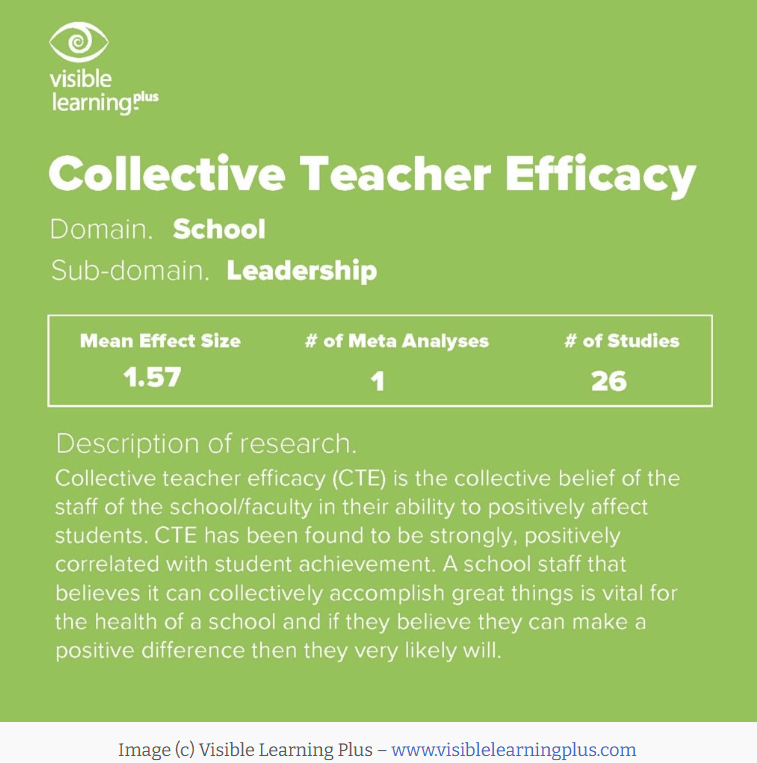
Research also shows us that putting mindset and team work together has a significant impact on student outcomes. John Hattie has looked at the impact of a wide variety of strategies over his career. He identified anything with an effect size of 0.4 or greater as having a positive impact . Collective teacher efficacy blows everything out of the water with an effect size of 1.57!!
- Reflect and Revise
Anytime you are trying something new or different, it is important to take time and reflect on what is working and what isn’t working. Evaluating and revising your plan can help you stay focused and on track.
Watch your mindset as you reflect on what’s working. Remember that even the most accomplished people were beginners once. Remind yourself that it is okay to not know all the answers right now as you are learning.
Celebrate the wins you do have – big and small! You got all the way through the lesson you planned today during your ELA block – woohoo! You remembered to include the vocabulary chunks in this week’s slide deck – Yes! All but 2 of your students were actually on topic during the turn and talk today – amazing!! Keep that positive momentum going while still focusing on the big picture.
As you move through a change, continue to ground yourself in the bigger picture also. Why are you making this change? What is the outcome you are looking for? The initial response may be – because my district said we had to. Okay. Now think about the reasoning why (hopefully they’ve shared that with you also). We are implementing a new knowledge based curriculum to improve student reading and writing outcomes. We are building a running habit because we want to feel like we can keep up and be stronger. It sounds cliche but remembering the “why” behind the change can be helpful in the moments when it feels too hard to keep going.
It can also be helpful when you are in the midst of a change to think about the timeline for the change. When we see changes in others, especially online, we can feel like things should happen overnight. In reality change takes time. Depending on what kind of change we’re talking about it can take a lot of time. Building a new habit can easily take 60 days but sometimes can take a lot longer. Implementing a new curriculum takes at least three years sometimes five. When building a new habit or practice, especially ones that replace something we’ve been doing for a long time, we have to give it time. We didn’t build the old practice overnight so we certainly aren’t going to solidify the new one overnight.
Along those same lines, we can’t change everything all at once. I am definitely guilty of having an all or nothing mindset when it comes to building new practices. Committing to small changes over time add up to bigger changes in the long run.
Implementing a new curriculum? Start with learning the format of the unit and lesson. Commit to teaching the lessons everyday and focus on that first. This may be the first year of implementation. Then in year two, you’ve established a firm foundation in the lessons, now let’s focus on scaffolding and differentiation in the tier 1 curriculum.
Want to run a marathon? Start by walking everyday and then commit to a 5K training program. Build a solid foundation of 5K miles over time. This could take six months or longer if you haven’t been working out at all.
- Keep Moving Forward
It’s okay to not love every minute of something new. It’s okay to have doubts and wonder if you’re doing something right. It’s okay to not feel like an expert or feel like you’re fumbling through. Just keep moving forward. The path may be steep but the view from the top is totally worth it!




“Around here, however, we don’t look backwards for very long. We keep moving forward, opening up new doors and doing new things, because we’re curious … and curiosity keeps leading us down new paths.”
Walt Disney’s Meet the RObinsons (2007)
- Riener, C. R., Stefanucci, J. K., Proffitt, D. R., & Clore, G. (2010). An effect of mood on the perception of geographical slant. Cognition and Emotion, 25(1), 174–182. https://doi.org/10.1080/02699931003738026
↩︎ - Schnall, S. Harber, K. D., Stefanucci, J. K., & Proffitt, D. R. (2008). Social support and the perception of geographical slant. Journal of Experimental Social Psychology, (44)5, 1246-1255. https://doi.org/10.1016/j.jesp.2008.04.011.
↩︎

 BetsyWright